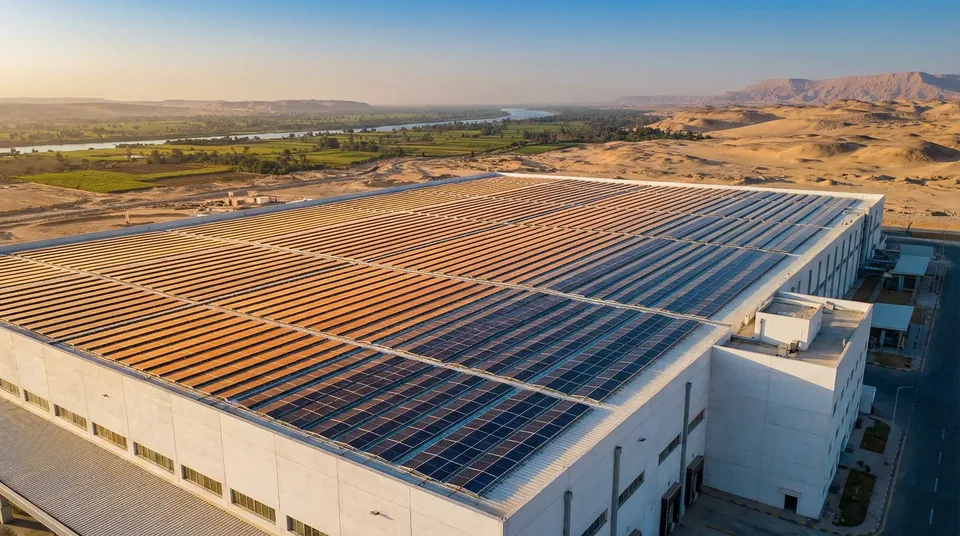
A promising site still needs its own assessment
A sunny location does not make every plant suitable. Irradiance, orientation, tilt, temperature, shading, dust and system losses affect output. Sunshine hours are not operating hours at nameplate capacity, and higher ambient temperature does not automatically improve panel efficiency.
Use official European Commission PVGIS for a location-based production estimate with stated system assumptions. It supplies data and modelling, not company endorsement or a production guarantee.
Assess the factory, not just the roof
- Daytime consumption and the timing of each shift.
- Roof type, structural condition and usable space after access paths and obstacles.
- DC distance from panels to inverter and AC distance to the connection point.
- Connection capacity and conditions confirmed by inspection and the utility.
- Investment, operation, maintenance and optional financing terms.
Output, savings and financial return differ
Output is measured in kWh. Savings depend on useful energy, tariffs and avoidable charges. Financial return also includes project cost, maintenance, financing and cash-flow timing. A factory with mainly nighttime demand requires a different assessment.
Do not assume every Egyptian installation produces twice as much as a German one: a valid comparison requires specified sites and consistent inputs. Compare purchase, financing, participation and power-purchase options on their own terms.
Prepare bills, a location link, roof information and shift times. Read industrial system costs, then discuss system purchase or industrial rooftop options. A preliminary offer supports a decision; final design requires inspection and engineering verification.